Quick Answer:
Meta Ads provides three primary audience targeting options: Core Audiences (defined by demographics, geographic locations, user interests, and behaviours), Custom Audiences (created from your own first-party data, such as website visitors or customer lists), and Lookalike Audiences (new users who share characteristics with your highest-value existing customers).
Understanding the right target audiences before launching or advertising your PPC ads on the Meta Ads platform is highly important across all industries. The Meta Ads platform provides a powerful ecosystem for businesses to promote their B2C products or B2B services on paid social, making it vital for creating brand awareness, driving engagement, and building up a high-quality customer base.
At Bidmark, we use these advanced parameters to serve ads across stories, reels, feeds, and audience network placements. To help you select the right framework and optimise your campaigns, here is a complete breakdown of the primary options available today.
How do demographic options work for Meta audience targeting?
Meta demographic targeting narrows ad delivery using specific user profile attributes, including age brackets, gender, and geographic location down to a 1-mile radius.
The demographics option enables you to target specific characteristics of audiences that could potentially become new customers, or to retarget your current audience pools. Bidmark utilises an array of specific demographics to make your paid social campaigns precise and relevant:
- Age: You can set a specific age range to tailor messages and serve ads to different cohorts, ensuring your budget is spent only on age brackets suited to your product.
- Gender: You can specify gender to promote relevant products. This allows you to optimise campaigns by creating separate ad sets for males and females, helping advertisers analyse distinct customer behaviours and control budgets efficiently.

- Location: Meta Ads allow advertisers to target or exclude locations by country, state, region, city, and postcode.
Important Location Update: Meta Ads removed the specific options for 'People living in this location', 'People recently in this location', and 'People travelling in this location'. The single consolidated location targeting option available is 'People living in or recently in this location'.
When setting a radius around a location, the maximum radius is 50 miles (approx. 80 km) and the minimum radius is 1 mile (approx. 1.6 km).

How do you target users by interests and behaviours on Meta?
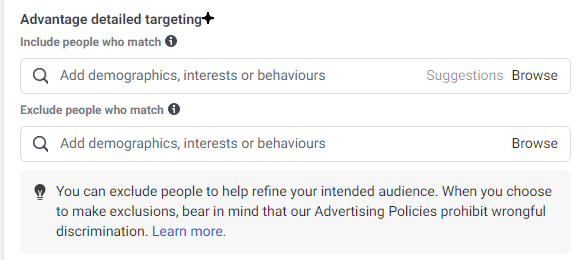
Meta detailed targeting analyses user activity across Facebook and Instagram to reach people based on their hobbies, purchase habits, device usage, major life transitions, and job titles.
Meta Ads’ detailed targeting options allow you to reach audiences based on deep contextual data gathered from user activity across Facebook and Instagram, such as page engagement and ad clicks.
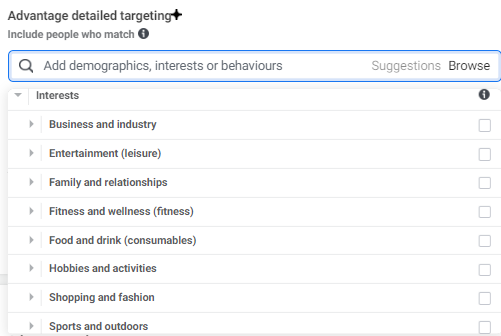
Interests
This allows you to define target audiences based on their specific hobbies, alignment with certain industries, entertainment preferences, and core activities.
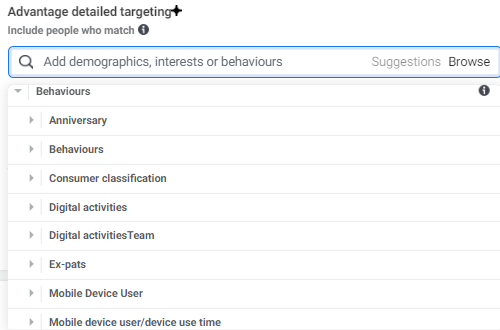
Behaviours
This targets users based on concrete digital and real-world habits. Key categories include purchase behaviour (such as Engaged Shoppers who regularly click call-to-action buttons), device usage (targeting specific mobile operating systems), and travel habits (such as frequent international travellers).
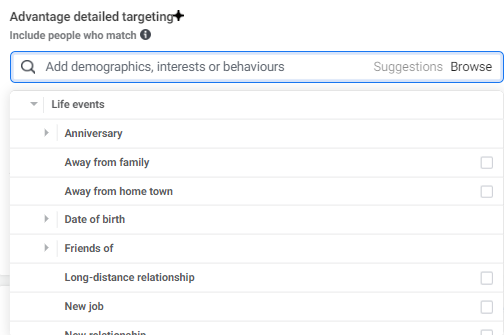
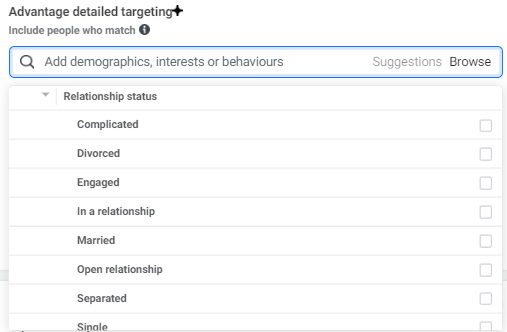
Life Events & Relationship Status
Meta allows you to target users during major life transitions, including anniversaries, new jobs, long-distance relationships, or being newly engaged/wed (tracked at 3-month, 6-month, and 1-year intervals). You can also segment by explicit relationship statuses, such as married, single, or divorced.
Education and Workplace
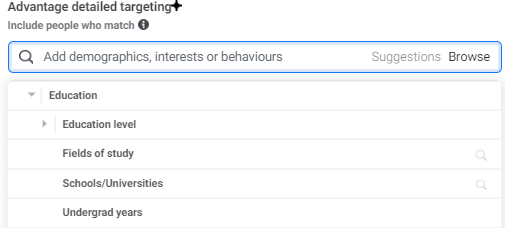
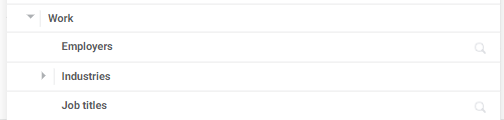
For B2B audience targeting, you can filter users by their education level, specific fields of study, undergrad years, employers, industries, and specific job titles.
Additionally, the workplace option on Meta Ads allows you to target users in their careers that are related to their employers, industries, and job titles.
Financial Targeting
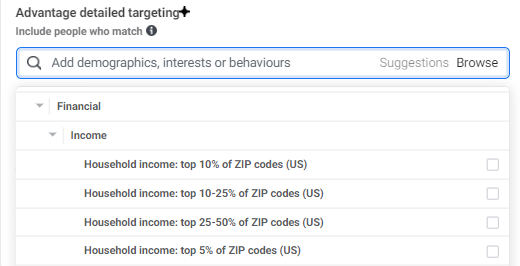
Suited to luxury brands and premium service providers, this option allows advertisers to target users based on household income percentiles (dependent on regional data availability).
Parents
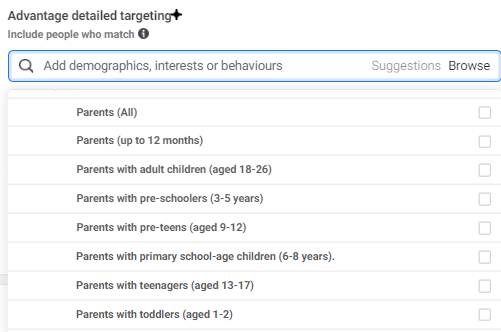
You can target users based on parenthood status, segmenting them by the specific age brackets of their children (e.g. parents of toddlers, parents of primary school children, or parents of teenagers), allowing for highly tailored family messaging.
What are Custom Audiences and Lookalike Audiences in Meta Ads?
Custom Audiences reach people who previously interacted with your business using first-party data, while Lookalike Audiences use machine learning to find new users who mirror your top customers.
A Custom Audience is a highly powerful option that allows you to reach individuals who have already interacted with your brand. By utilizing first-party data, Bidmark sets up these audiences using two distinct source types:
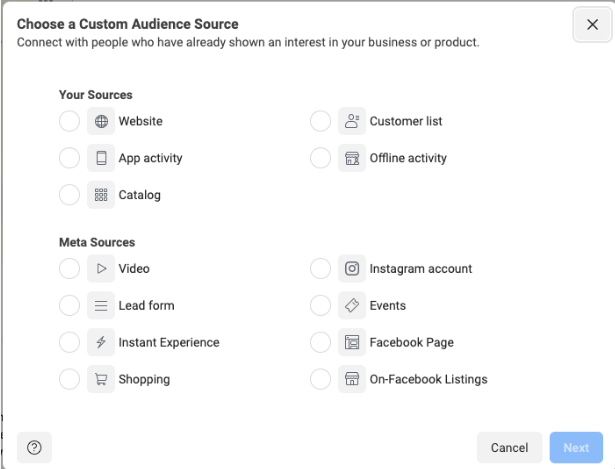
- Your Sources: Website visitors (tracked via the Meta Pixel or Conversion API), custom CRM customer lists, app activity, and offline activity.
- Meta Sources: Users who have engaged with your videos, Instagram account, Lead Forms, Events, Instant Experiences, or Facebook Page.
Lookalike Audiences
Once a Custom Audience is established, you can build a Lookalike Audience. This system uses Meta's machine learning algorithm to find new users who mirror the traits of your source audience. Advertisers can select the target country and a percentage scale from 1% to 10%—where 1% represents the users who most closely match your seed audience.

How can you exclude specific audiences to improve Meta campaign efficiency?
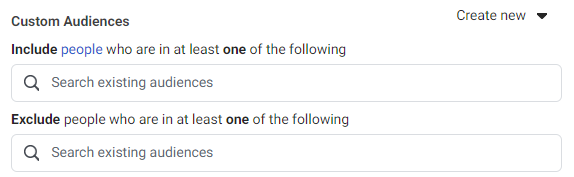
Audience exclusions in Meta Ads prevent wasted ad spend by suppressing current customers or specific CRM lists from seeing prospecting campaigns.
Excluding certain audiences from your campaigns ensures that you do not waste ad spend on users who cannot benefit from or are unlikely to convert on your offer. For example, excluding "Past 30-Day Purchasers" from an introductory brand awareness campaign ensures you are only paying to reach fresh prospects.
2026 Optimisation Note: Meta has officially retired detailed targeting exclusions (interest and behaviour-based exclusions). Consequently, advertisers must now rely on Custom Audience exclusions—such as uploading an offline CRM list or using pixel data—to remove existing customers or specific segments from active ad sets to protect your cost-per-acquisition (CPA).
Conclusion
Understanding and leveraging the intricacies of Meta Ads targeting options is paramount for businesses aiming to make meaningful connections with their audiences. Whether it's honing in on demographics, interests, life events, or leveraging custom and lookalike audiences, Meta Ads provides a robust toolkit to refine campaigns and maximise impact.
By delving into these targeting options with precision and strategy, businesses can not only enhance their reach but also cultivate deeper engagements. The team at Bidmark believes the key to unlocking paid social success lies in harnessing the power of hyper-targeted advertising data. Contact Bidmark today to discover how we can refine your audience targeting and maximise your digital return on investment.
Frequently Asked Questions
What is the difference between Advantage+ Audiences and original targeting options?
Advantage+ Audience is Meta’s AI-driven targeting automated framework. Instead of strictly limiting your ads to your chosen demographics or interests, Meta uses your selections as a "suggestion." If the AI detects conversions outside of your core selections, it will automatically expand your reach. Original targeting options, by contrast, act as strict, unyielding boundaries.
How has Apple's iOS14 privacy update affected Meta Custom Audiences?
The iOS14+ tracking prompts severely limited the data collected via the traditional Meta Pixel on Safari and mobile apps. To counter this drop in custom audience matching accuracy, businesses must deploy first-party data solutions like Meta's Conversions API (CAPI) to pass server-side events directly to the ad platform.
Can you target specific B2B companies or business owners on Meta Ads?
Yes. While LinkedIn is the default for B2B, Meta allows you to target business owners through detailed behaviour targeting such as "Facebook Page Admins", "Small Business Owners", or via specific job titles and workplace industries in the demographic parameters.

Categories:
Meta |
